
Video editing and framing shape what viewers see, understand and care about. Sharp images, an expensive camera and an attractive location can still produce a sequence of disconnected shots. Each image may look good on its own. Together, they need to communicate something.
The starting point for this article is a familiar frustration: videos in which shots seem to be thrown together simply to keep the screen busy. Every beat gets a cut, transitions compete for attention and the underlying message remains unclear. This is a question of editorial judgement, whatever equipment or era we are discussing.
Editing then and now: what are we comparing?
Comparing the past with the present can easily turn into nostalgia. Film history includes rapid cutting, experimentation and deliberate breaks in continuity. Excellent, thoughtful work is being made today, too. The age of a technique tells us little about its quality.
A more useful comparison concerns the starting point. One approach begins with the action: what is happening, whose perspective are we following and what information should the next shot add? Another begins with effects and attractive images. Relationships between shots can get lost when surface appeal drives every decision.
Current tools make alternative edits, colour work and multiple delivery formats easier to explore. That flexibility is useful when it supports more precise choices. Having another transition available does not mean the scene needs it.
Framing starts with what the viewer needs to see
Before recording, decide what matters in the frame. A wide shot can establish a place and the people within it. A medium shot can bring us closer to the action. A close-up can direct attention to an expression, reaction or detail. Each shot should have a function within the sequence.
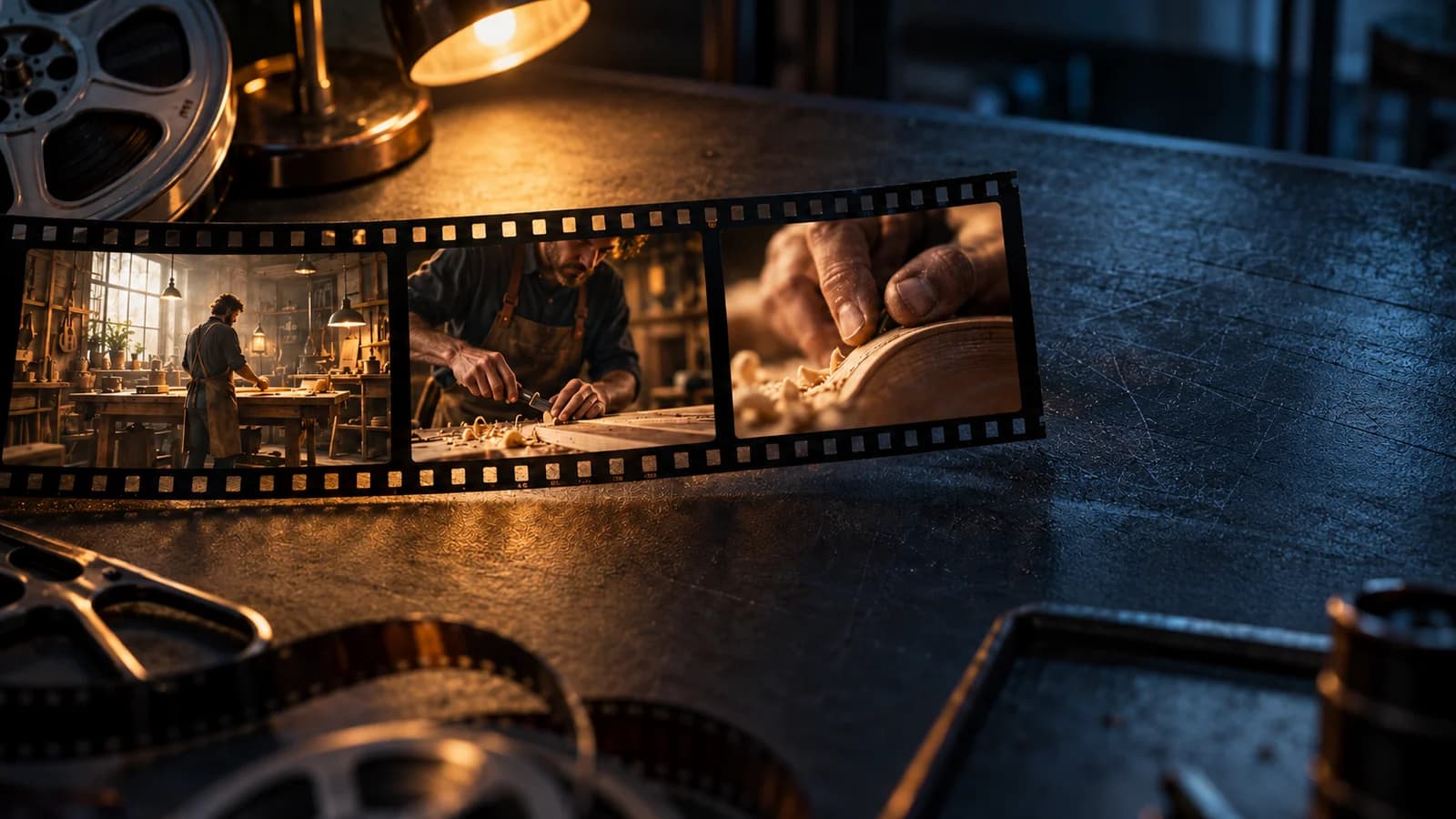
Imagine filming a woodworker in a workshop. A wide shot introduces the working space. A closer view shows how a tool moves across the wood. A detail reveals the mark it leaves and the texture of the surface. The information builds from one image to the next. This is an illustrative scenario, rather than an account of a client production.
If we record only beautiful details, the edit may lack the shot that explains who is working and what they are making. If we record only the room, the action and detail will be missing. A shot plan should give the editor enough material to tell the whole scene.
The same footage can tell two different stories
One version of our workshop video could combine sawdust, a camera move past a window, a tool, a fast turn and another wood detail. Music maintains the pace. The images are pleasing, but the viewer may still have no idea what is being made.
A second version could introduce the object, follow a hand movement and show the precise action of the tool. A cut to the woodworker's face reveals concentration. The next image shows the result of that action. The relationships between shots now explain both the work and the person doing it.
Both versions could have the same running time. Information and its order make the difference. A decorative sequence might suit a brief atmospheric opening. Explaining a skill, product or service requires the relevant substance as well.
Editing rhythm comes from action, sound and expectation
Tempo describes how quickly shots follow one another. Rhythm also involves their arrangement, variation and relationships. The Croatian Film Encyclopedia's entry on film rhythm makes this distinction. Two sequences with similarly short shots can feel very different.
A cut can follow a movement, introduce information or register an emotional change. Sometimes the useful choice is to stay on a face after a line of dialogue. That pause gives the viewer time to notice a reaction. Cutting away immediately may remove the most revealing part of the moment.
Music can guide an edit without dictating every cut. A tool, footsteps, breathing and room ambience also tell us about the space and the action. Covering everything with music can remove some of that physical presence.
Every cut should have a reason
Ask what the next shot contributes. It might reveal a reaction, change perspective or show a detail. It might deliberately interrupt an expectation. The editor needs to understand the effect of that choice.
Movement continuity, eyelines and spatial relationships help viewers stay oriented. These conventions can be broken intentionally to create unease or a jump in time. An accidental reversal during an ordinary action can instead introduce confusion that serves no purpose.
As a practical check, swap the position of two shots. If the message stays exactly the same, consider whether the sequence is developing an idea or simply maintaining visual activity. This is a diagnostic exercise, rather than a universal rule. Atmospheric and abstract work may deliberately use a looser structure.
Short social videos need a clear idea
A Reel or short promotional video can open on its most interesting detail. It then needs enough context for viewers to understand what they are watching. Shot selection matters especially in a short format, where there is little time to explain.
A product video might show a practical problem, demonstrate how the product works and reveal the result. Each moment can be brief. Speed becomes useful when it supports a clear idea. Our guide to social media video formats covers planning for different channels.
Converting a horizontal video to a vertical format also calls for a fresh look at composition. Cropping can remove another person, an important object or an eyeline. Planning for several formats means deciding in advance what must remain visible in each version.
How to assess whether an edit works
Before signing off a video, check these points:
- Can you describe its main message in one sentence?
- Can viewers understand who is present and what is happening?
- Does each change of shot add useful information or feeling?
- Do important actions and reactions have enough time?
- Do sound and music support what the images show?
- Does the main subject remain clear in the mobile version?
Watch once without music to examine the relationships between images. Then assess the complete sound mix. Work built around dialogue or narration needs to be judged with those elements in place as well.
What to discuss when commissioning a video
A useful brief states what viewers should understand, who the audience is and where the video will appear. References help when you explain what appeals to you: pacing, photography, the portrayal of a person or the relationship between image and sound.
Discuss the filming plan, too. If a video must explain how a product is made, the shoot needs to capture the key stages and the connections between them. Editing can shape footage, but it cannot always recover an action that was never recorded.
Explore our portfolio for different approaches and our video editing and colour grading service for post-production support. To discuss a project, send a brief with your objective, formats and available footage.
A well-chosen shot gives viewers a reason to look. A well-built edit gives them a reason to keep watching.
The cover image is an AI-generated editorial illustration.


